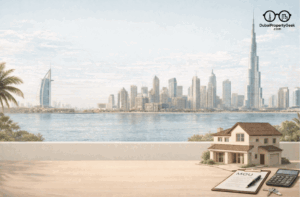
Is the Dubai Dream Over Because of the War
Crisis?
If you’ve been scrolling through headlines about missile interceptions over the Gulf lately & wondering whether your Dubai property plans just went up in smoke, believe me, you’re not alone.
Since regional tensions escalated earlier this year, almost everyone is asking, “Is Dubai still safe to invest in?” That’s a fair question, though.
After all, no one would want to put their life savings into a market that’s shaking, right?
In short, it’s not over yet! Because recent figures clearly show that the housing market of Dubai is still enjoying record demand, and in fact, there’s a long way to go.
For example, the Dubai Land Department reported AED 252 billion in real estate transactions in Q1 2026, which is an approximately 31% jump year-on-year.
Why Are Investors Asking This Question?
Well, the way crises have provoked fear among investors is quite natural.
Earlier in 2026, when drones and missiles were intercepted all over UAE airspace, the Dubai Financial Market’s Real Estate Index dropped 21% within just days.
No doubt, that was a huge shock to everyone, and even the exchange got closed for two sessions straight as a precaution. Buyers paused to “wait for the clarity,” and brokers reported site-visit cancellations.
The ValuStrat Price Index recorded its first monthly decline since 2020, down close to 5.9% in March. And that’s alarming to anyone new to the market.
But the DFM Real Estate Index tracks developer stock prices (companies like Emaar and Aldar), not the actual resale value of an apartment in Dubai Marina.
Conflating the two is where much of the panic comes from.
How Global Conflicts Affect Investor Sentiment
It’s not hidden that conflicts significantly trigger a flight to safety. And for the Gulf, that image took a hit.
Reuters also noticed that the US-Israel-Iran conflict “pierced Dubai’s image as a safe haven for the world’s wealthy.”
And here’s what happened:
➔ Large developers’ stocks drastically fell, and analysts started warning about the market slowdown.
➔ Beyond that, Goldman Sachs estimated that UAE property transactions fell 49% month-on-month in early March.
➔ Some sellers began offering bulk discounts of 10–15% on particular units.
But remember, these effects were limited and short-lived. Although some deals slowed down, the pipeline of investment didn’t dry up at all.
What Makes Dubai’s Real Estate Market Resilient?
Dubai’s resilience surely stems from powerful fundamentals. It’s a business hub of global importance and a diverse economy (finance, tech, logistics, tourism, etc.), as well as a tax-free regime that attracts wealth.
Below are a few structural factors that separate today’s market from a speculative market of 2008:
● Low Reliance on Debt: Roughly 82-86% of transactions are cash-based, and that means, there’s far less exposure to forced selling if credit somehow tightens.
● Population Growth: In 2025, the population of this city crossed 4 million, with 175,000–225,000 residents expected this year (2026). And no, that’s not speculation
but a structural demand.
● Regulatory Maturity: Post-2008 reforms, including mandatory escrow accounts and RERA oversight, protect-off-plan buyer funds far better than during the very first
boom-bust cycle.
● Diversified Capital Sources: Indian nationals account for approximately 20-22% of foreign buyers, alongside high demand from Europe, the UK, China, and Russia.
All these factors together create a “moat” around Dubai real estate… one that has so far kept fundamentals fully intact even as headlines flash unpredictability and chaos.
What Current Market Data Says
Apparently, it might seem that Dubai Dream is collapsing, but the recent numbers tell a completely different story.
| Metric |
Peak conflict (Feb–Mar
2026) |
Post-de-escalation (Apr–Jun
2026)
|
| DLD weekly transaction value |
~AED 11.9 billion |
Rose ~51% the following
week |
| Monthly residential sales |
Softened |
13,766 sales, AED 32.66 bn in
June (+31.3% MoM) |
H1 2026 residential
transactions |
– |
79,281 deals worth AED
221.4 billion |
Foreign investment (Q1
2026) |
AED 148.35 billion (+26% YoY) |
Sustained through H1 |
| Rental yields |
6–8% average |
Holding steady |
Believe it or not, June 2026 marked Dubai’s second-strongest first on record, with almost 29,312 new investors entering in Q1 alone.
That one reality is enough to know that the market is not even close to a “structural decline.”
Should Investors Be Concerned?
Not really. Short-term precautions are fine. But if we talk about geopolitical uncertainty, it can definitely make some buyers pause, sit, and wait for more clarity.
However, that doesn’t mean Dubai’s property market fundamentals have changed.
Because honestly, investors are still active. The only difference is that they are now taking more time to evaluate good opportunities—that’s all. And you can do the same.
A study further reveals that Dubai recovered AED 761 billion in real estate transactions in 2024, which marks a 36% increase compared with 2023 Not only this, but the market attracted more than 110,000 new investors, highlighting international demand despite global crises or uncertainties.
In short, if you’re:
● End-User or Long-Term Investor → These cost drips could be a good buying opportunity
● Timing the Market or Highly Risk-Averse → You need to proceed with more caution.
For many, the rationale to “wait for the war to end” really overlooks Dubai’s track record: it consistently rebounds when global capital flows resume.
Opportunities for Long-Term Investors
Every previous Dubai downturn has created an entry window for investors who stayed rational, consistent, and worked hard, while others panicked.
If you’re also looking for long-term opportunities at this time, consider:
- Ready homes in established communities (Downtown Dubai, Dubai Marina, Business Bay). They have proven to be more resilient than off-plan stocks during unpredictable
periods.
- Rental yields also prove to remain a genuine draw, at 6-8%, comfortably outperforming New York (~3.9%) and London (~3.5%). That said, smart investors widely opt for this option.
- Visa & policy incentives are a go-to choice for many. Residency-by-investment programs (Golden Visas) and easing of purchase rules keep foreign demand anchored.
Holding property secures these benefits.
- Dubai’s market offers a range of options (apartments, villas, land) and this diversification is something you must value. In uncertain times, income-producing real
estate can provide steady cash flow.
Frequently Asked Questions
Q1. Has the Iran-Israel conflict caused Dubai property prices to crash?
No. Physical prices noticed a modest 5-6% correction in some segments during peak uncertainty, mostly reversing recent rapid gains. The sharper 21% drop in headlines basically referred to the DRM Real Estate Index, which tracks developer stocks, not resale values.
Q2. Is it still a good time to invest in Dubai real estate in 2026?
Yes, it is. Data through mid-2026 shows transactions and foreign investment recovering significantly, with H1 2026 residential sales reaching AED 221.4 billion. In the end, it all depends on your goals, but still, the fundamentals remain the same.
Q3. How did Dubai’s market perform during past crises like 2008 and COVID-19?
Prices fell around 40-60 percent after 2008 but, fortunately, recovered to new highs by 2013-2014. The same way, COVID-19 didn’t slow the market either. In fact, it triggered one of its strongest growth phases.
Q4. Are foreign investors still buying property in Dubai?
Of course, yes. Foreign investment value rose 26% year-on-year in Q1 2026, and nearly 29,312 new investors entered that quarter. So yes, nothing stops people from buying valuable properties in this city of lights.
Read More Related Blogs